
How to Quiet Your Mind: The Eye-Opening Secret You Need to Know
You finally get a chance to relax, but your brain has other plans.
You replay conversations, think about tomorrow, analyse what somebody meant and mentally jump between a dozen different things at once.
If you have been trying to figure out how to quiet your mind, here is the missing piece: a busy mind is not just a thinking problem, it’s a nervous system problem.
When your nervous system has been under stress for a long time, your brain learns to stay switched on, constantly analysing, scanning, predicting and looking for problems to keep you safe.
Learning how to quiet your mind starts with helping your nervous system realise it does not need to work so hard to keep you safe.
But what does your nervous system actually do when you're stressed?
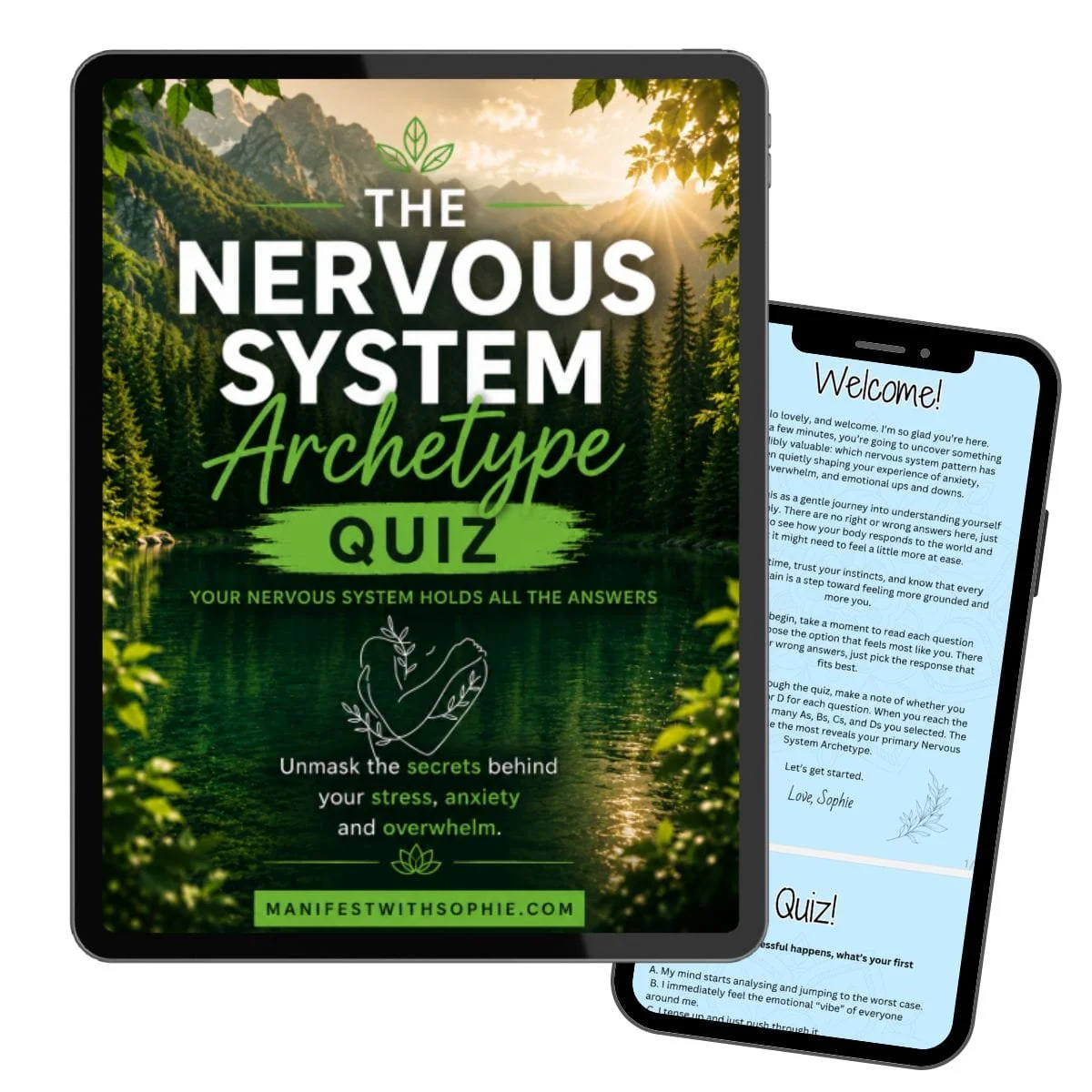
Are you The Overthinker, whose brain analyses absolutely everything? The Emotional Sponge, who absorbs everyone else's moods? The High-Functioning Freeze, who keeps getting everything done while feeling overwhelmed underneath? Or The Shut-Down Freeze, who disappears into avoidance when everything becomes too much?
Take my free Nervous System Archetype Quiz to find out which of the four you are. Your result might explain a LOT about why your brain reacts the way it does.
What Is Mental Clarity?
Before we talk about quieting your mind, it helps to understand what mental clarity is.
Mental clarity does not mean having a completely empty mind.
You are still going to have thoughts, ideas, worries, memories and random observations. That is what brains do.
Mental clarity is more about being able to think without feeling like your attention is constantly being pulled in ten different directions. It’s being able to process each piece of information at a time, with intention without being bombarded with a million other thoughts at once.
When you have mental clarity, it is easier to focus on what is actually in front of you.
You can make a decision without analysing it for the next three hours.
You can notice a thought without automatically following it down a rabbit hole.
You can think clearly, choose calmly and interact with others peacefully without feeling overloaded.
When you are lacking mental clarity, your mind can feel crowded.
You might struggle to concentrate, constantly jump from one thought to another, replay conversations, worry about future situations or feel like your brain never properly switches off.
So when you are searching for ways to quiet your mind, what you may really be craving is this feeling of mental space.
Why Is My Mind So Loud All the Time?
When your nervous system has been under stress for a long time, it can get used to staying in a more alert state.
And when your body is on alert, your brain usually is too.
It starts scanning for anything that might need your attention, anything that could go wrong, anything you may have forgotten or anything you might need to prepare for.
That can look like:
Did I say something wrong?
Why did they reply like that?
What do I need to do tomorrow?
What if something goes wrong?
Have I forgotten something?
What if they are annoyed with me?
How am I going to get everything done?
Your brain is not doing this randomly.
It is trying to keep you one step ahead.
If your nervous system has learned that staying alert helps you feel more prepared, your mind can keep analysing, predicting and rehearsing even when there is no immediate problem to solve.
That is why overthinking can feel so difficult to switch off.
The thoughts are not happening in isolation. They are part of a system that has become used to looking for what needs your attention next.
So even when you are technically safe, your brain can keep searching for something to fix, prevent or prepare for.
And that is how you end up going around the same mental loops again and again.
The Secret to Quieting Your Mind Isn't Actually in Your Mind
Here is the part that changes everything.
When your nervous system has been stuck in a state of high alert for a long time, usually after years of stress, anxiety, overwhelm, unpredictability or constantly feeling like you have to stay on top of everything, that alert state does not just show up in your body.
It shows up in your thoughts too.
Your shoulders tense.
Your jaw clenches.
Your breathing becomes shorter.
Your stomach tightens.
You feel restless, irritated or unable to fully settle.
And at the same time, your mind speeds up.
You analyse.
You predict what might happen.
You look for problems.
You mentally prepare for things that have not even happened yet.
You try to stay one step ahead.
These are not two separate problems.
They are both signs that your nervous system is still behaving as though it needs to keep you alert, prepared and protected.
And this is the missing piece.
If you only focus on changing your thoughts while your nervous system is still stuck in that high-alert state, you are working on the symptom without changing what is driving it.
You can tell yourself to stop overthinking.
You can challenge every thought.
You can try to think more positively.
But if your body still feels like it needs to stay on guard, your brain will keep finding things to analyse, predict and worry about.
When you start working with the body and helping your nervous system come out of that constant state of alert, your thoughts begin to follow.
The mental noise softens.
The urge to analyse everything reduces.
Your brain stops searching so hard for the next thing to fix, prevent or prepare for.
That is the real secret to learning how to quiet your mind.
You do not start by forcing the thoughts to change.
You start by changing the state underneath them.
Why Trying to Force Your Thoughts Away Can Make It Worse
Imagine you notice yourself overthinking.
You immediately think:
I need to stop thinking about this.
Then another thought arrives.
Why can't I relax?
Then:
I am doing it again.
Then:
I need to sleep.
Then:
If I don't sleep soon, I am going to feel awful tomorrow.
Now you are not just thinking about the original problem.
You are thinking about the fact that you are thinking.
You have accidentally created another problem for your brain to solve.
This is one of the reasons trying to force your mind into silence can backfire.
Instead of demanding that your thoughts disappear, it can be much more helpful to reduce the sense of urgency around them.
A thought can exist without requiring action.
A question can exist without needing an immediate answer.
A worry can appear without you having to mentally investigate it.
That distinction can create much more mental clarity than trying to force your brain to become completely blank.
How to Quiet Your Mind and Find More Mental Clarity
If your nervous system has spent years stuck in a state of stress and high alert, quieting your mind is not about finding the perfect thought-stopping technique.
It is about helping your nervous system learn that it does not need to stay on guard anymore.
And that happens through the body.
The important part is consistency.
Doing one calming exercise when you are already overwhelmed can help in the moment, but the bigger change comes from giving your nervous system regular signals of safety every day.
Over time, your system becomes less reactive. Your body spends less time braced for something to happen, and your brain has less reason to constantly analyse, predict and prepare.
That is when the mental clarity starts to follow.
1. Regulate Your Body Before You Try to Regulate Your Thoughts
When your mind starts racing, your first instinct might be to reason with it.
Instead, start with your body.
Slow your breathing. Drop your shoulders. Unclench your jaw. Feel your feet against the floor. Stretch. Place a hand on your chest or stomach and notice the physical sensation underneath it.
You are giving your nervous system information.
You are showing it:
There is nothing I need to fight, fix or prepare for right now.
When the body begins to come out of high alert, the brain does not need to work quite so hard either.
This is why calming the body first can be far more effective than trying to argue with every anxious thought individually.
2. Give Built-Up Stress Somewhere to Go
A nervous system that has been running on stress for a long time can carry a lot of physical activation.
You might feel restless, tense, fidgety, irritable or like you simply cannot settle.
Movement gives that activation somewhere to go.
Try walking, stretching, dancing, shaking out your arms and legs or doing another kind of movement that feels good to your body.
This does not need to be intense exercise.
Even a ten-minute walk can help shift you out of sitting completely still while your brain goes around the same mental loops.
Movement also brings your attention back into your body and into what is happening right now.
The more often you give your body healthy ways to move through stress, the less it has to hold onto.
3. Give Your Nervous System Small Signals of Safety Every Day
You do not need an elaborate hour-long nervous system routine.
Small things, repeated regularly, matter.
That might look like:
Taking a few slow breaths with a longer exhale
Going for a walk without your phone
Stretching for five minutes
Sitting somewhere quiet with a warm drink
Listening to music that genuinely relaxes you
Spending a few minutes outside
Letting your body shake or move when you feel tense
Grounding yourself by noticing what you can see, hear and feel around you
None of these things are magic on their own.
What matters is the message your nervous system receives repeatedly:
I can slow down. I can be still. I do not have to be alert every second.
That repetition is what begins to change the pattern.
4. Stop Waiting Until You Are Completely Overwhelmed
If the only time you try to calm your nervous system is when you are already at breaking point, you are constantly trying to drag yourself back down from the top of the stress response.
Instead, build regulation into ordinary days.
Take the walk before you are desperate for one.
Stretch before your shoulders are painfully tense.
Take a few slow breaths when you notice yourself rushing.
Give yourself ten quiet minutes before your mind feels completely overloaded.
Think of it less like putting out a fire and more like stopping the fire from getting so big in the first place.
The more often your nervous system experiences calm while nothing is wrong, the more familiar that state starts to become.
5. Reduce the Signals Telling Your System to Stay Alert
You can practise nervous system regulation every day, but it is also worth noticing what keeps pushing you back into constant stimulation.
Rushing from one thing to another.
Checking notifications every few minutes.
Never properly finishing work.
Constantly consuming information.
Keeping twenty unfinished tasks in your head.
Never allowing yourself to do absolutely nothing.
All of these can keep reinforcing the message that there is always something else requiring your attention.
Create small pockets where nothing needs to happen.
Write things down instead of carrying them mentally.
Decide what can wait until tomorrow.
Put your phone down occasionally without immediately replacing it with another form of stimulation.
Give your system opportunities to experience what it feels like when there really is nothing it needs to deal with.
6. Give Your Nervous System Time to Learn a New Pattern
If your nervous system has spent years learning to stay alert, it will not unlearn that pattern after one breathing exercise.
Regulation works through repetition.
Each time you slow your breathing, move your body, release tension, ground yourself or properly rest, you are reinforcing a new message:
I do not need to stay switched on all the time.
Over time, your baseline begins to change. You will feel less tense, react less intensely, replay things less and find it easier to relax.
Why Your Mind Might Get Even Louder at Night
If your mind suddenly seems to come alive the second your head touches the pillow, you are definitely not alone.
During the day, there is usually plenty competing for your attention.
You are working, talking, driving, walking, cleaning, replying to people, scrolling or thinking about what you need to do next.
Then everything goes quiet.
There are fewer distractions.
And suddenly your brain has an opportunity to bring everything you have not processed to the surface.
That can be why nighttime becomes the moment when you remember an awkward conversation from six years ago.
If this happens regularly, try giving your brain a chance to "close" the day before you actually get into bed.
Spend five minutes writing down what you need to remember tomorrow.
Write down anything your brain keeps trying to solve.
Then ask yourself whether any of it genuinely requires action tonight.
If it does not, leave it on the page.
Follow this with something physical and calming.
Stretch.
Take a few slower breaths.
Notice the weight of your body against the mattress.
Relax your shoulders.
Unclench your jaw.
You are not trying to force yourself to sleep.
You are helping your whole system recognise that there is nothing else it needs to do right now.
Mental Clarity Does Not Mean Having an Empty Mind
If you have been wondering how to quiet your mind, the answer is not to fight your thoughts harder. It is to help your nervous system feel safe enough that your brain no longer needs to stay constantly alert.
The goal is not:
"I need to stop thinking."
It is:
"My brain does not need to work this hard to keep me safe."
That is where real mental clarity begins.
And if you want to understand why your nervous system reacts the way it does, take my free Nervous System Archetype Quiz to discover whether you are The Overthinker, The Emotional Sponge, The High-Functioning Freeze or The Shut-Down Freeze.
Read These Next
Why Do I Feel Like Everyone Is Judging Me?
Good next step for someone whose “loud mind” tends to scan other people's reactions.
5 Signs You’re Overexplaining a Simple Decision
Very closely related to an overactive, hyper-alert brain without being another general overthinking post.
Why Does Seeing Friends Together Without Me Hurt So Much?
This takes the reader into one specific trigger and shows how the same nervous-system pattern can show up in relationships.
