
How to Stop Worrying About the Future: The Secret You Need to Know
You are lying in bed and suddenly your brain starts playing out every possible thing that could go wrong in the future.
You worry about the future, tomorrow, a month from now, years from now.
You worry about money, your relationship, your kids, your health, your parents’ health.
Before you know it, it is 3am and you have barely slept because your mind has spent hours preparing you for problems that have not even happened.
Maybe it happens in the middle of your workday instead. You suddenly think, “What if I lost my job?” and within minutes you are worrying about how you would pay the bills, how you would support your family and what would happen if you could not find another one.
Or maybe your child gets into a little trouble at school and your mind instantly races years ahead, picturing them struggling at 25 because they failed one maths test.
If you are desperately trying to figure out how to stop worrying about the future, you already know how exhausting this can be.
But it does not have to keep feeling this way.
In this post, we are going to look at what actually causes you to worry about the future, the one secret that changes everything, and practical steps that can help bring you back to a calmer state of mind.
→ Why Worrying About the Future Is a Nervous System Response
→ Why Trying to Control the Future Keeps You Stuck in Worry
→ Why Worry Feels Urgent Even When Nothing Is Wrong Right Now
Worrying About the Future is a Nervous System Response
Here is the part that changes everything: Constant worrying is not simply your brain thinking too much. It is your brain responding to a nervous system that is detecting potential threat.
You probably think worrying about the future is a problem with your mind.
Maybe you have told yourself to “just stop worrying” or tried to force yourself to “think positively.”
You already know how that usually goes. It might make you feel better for an hour, or even for the rest of the day, but sooner or later another worry appears and you are right back where you started.
After years of this, you might even believe that worrying is simply part of your personality. Maybe you have always been “a worrier.”
But it goes much deeper than that.
Worry is closely connected to your nervous system and its response to perceived danger.
Your nervous system has an enormous influence on how you experience the world around you. Its autonomic branch controls many of the things your body does automatically, including your heart rate, breathing, blood pressure and digestion.
But it is also deeply involved in your stress response.
And understanding that response can completely change the way you look at your worrying.
How Your Nervous System Turns Potential Danger into Worry
One of your nervous system’s protective jobs is to help you respond quickly when your brain detects danger.
Imagine you are walking through the woods and suddenly realise there is a lion running towards you.
Your sympathetic nervous system activates the fight-or-flight response. Adrenaline is released, your heart beats faster, your breathing speeds up, your muscles tense and more readily available energy is sent into your bloodstream.
Your body is preparing you to do something.
You could run away from the lion.
Or, if you were feeling particularly brave, bonk it on the head and fight for your life.
Either way, all of those changes are incredibly useful because you need energy, strength and alertness right now.
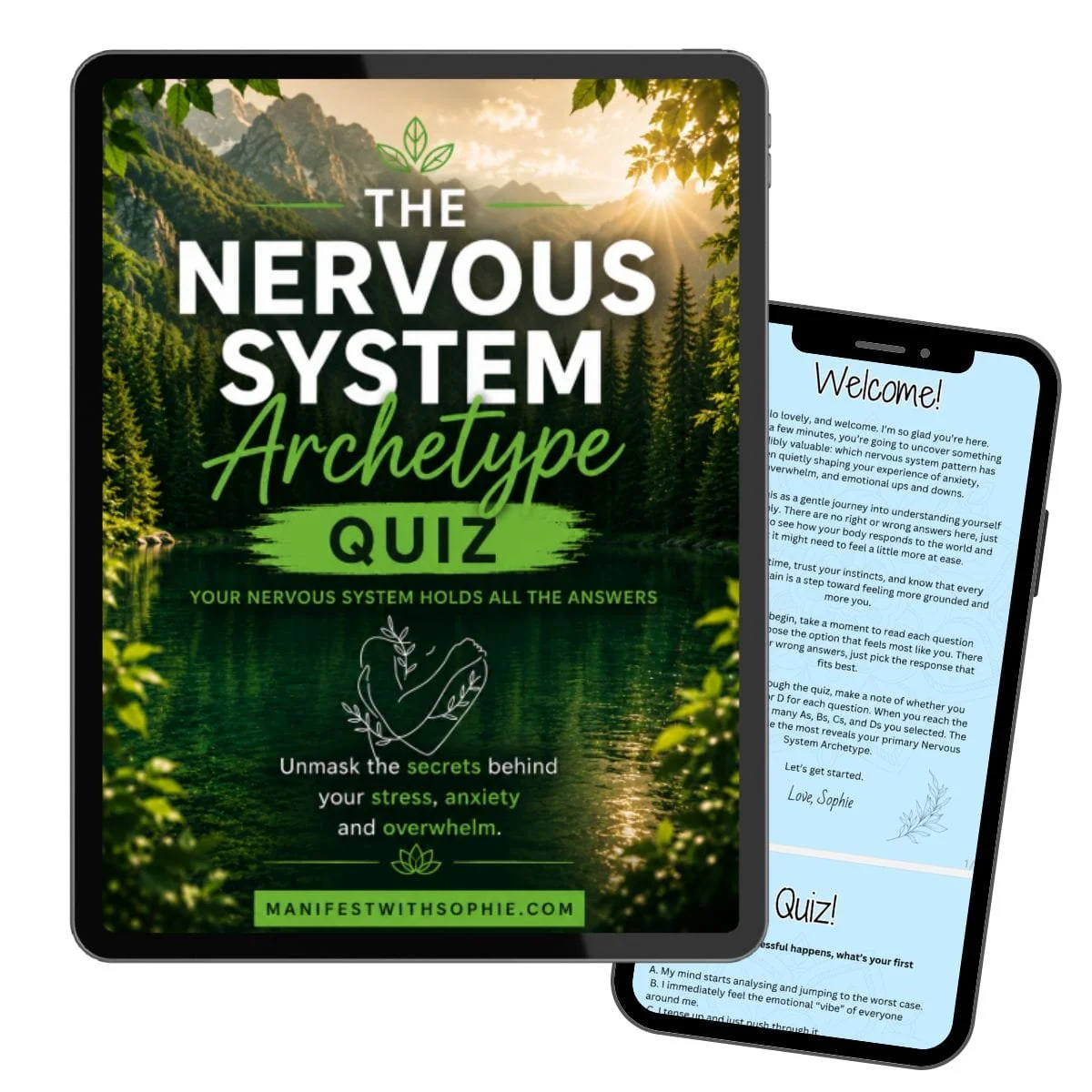
If you want to understand how your own nervous system tends to respond to stress, take my free Nervous System Archetype Quiz.
There are four nervous system archetypes, and you will likely recognise yourself strongly in one of them. Your result will help you see the patterns your nervous system falls into when it feels overwhelmed or unsafe, so you can start understanding yourself better and learn what may help you calm worry, overthinking and stress more effectively.
Once the danger has passed and your brain no longer believes you are under threat, the stress response can begin to settle.
Your parasympathetic nervous system acts almost like a brake, helping slow your heart rate, support digestion and move your body back towards its calmer “rest-and-digest” state.
The problem is that these days, most of us are not running away from lions.
The threats your brain reacts to are much more likely to be an angry email from your boss, money problems, relationship uncertainty, family stress, health worries or something happening with your children.
Your stress response can still activate even though there is no physical predator standing in front of you. Psychological stress and perceived threats can trigger many of the same fight-or-flight processes in the body.
And when you are already chronically stressed or highly sensitive to uncertainty, your alarm system can become much easier to trigger.
Something relatively small happens, and your body responds as though there is a much bigger threat that needs your immediate attention.
Your child fails a maths test.
That is the event.
But your nervous system sounds the alarm, your body shifts into stress and suddenly your brain starts searching for what this could mean.
What if they start falling behind?
What if they fail their exams?
What if they cannot get a good job?
What if they are struggling financially at 25?
Cut to you practically pulling your hair out worrying about a future that does not even exist yet.
Uncertainty can be so powerful for chronic worriers. Research has repeatedly linked difficulty tolerating uncertainty with greater worry because when the outcome is unknown, your brain has room to keep searching for potential threats.
So, when you find yourself worrying about something that might happen tomorrow, next month or ten years from now, your brain is not doing it simply because you are “a worrying person.”
Your threat system has identified something as potentially unsafe, and your mind is responding to that alarm by looking into the future for what could go wrong.
And that is the part we need to work with if we want the worrying to calm down.
Why Trying to Control the Future Keeps You Stuck in Worry
When you are worried about the future, your brain often tries to make you feel safer by gaining as much control as possible. You plan for every outcome, rehearse what you would do if something went wrong and keep searching for answers that might finally make you feel certain.
The problem is that the future can never be completely controlled. There will always be something you cannot predict, someone whose behaviour you cannot guarantee or an outcome you cannot know in advance.
So, every time your brain tells you, “I can relax once I know what is going to happen,” it sets you an impossible task. Instead of switching off, it keeps scanning for the next uncertainty that still needs an answer.
You answer one “what if?” and another appears. Then another. Before long, your brain has learned that uncertainty itself is something dangerous that needs constant attention.
That is how trying to control the future keeps the worry cycle going.
The goal is not to know exactly what is going to happen. It is to become more comfortable with the fact that you do not know yet, and you are still okay right now.
Why Worry Feels Urgent Even When Nothing Is Wrong Right Now
Worry feels urgent because your nervous system does not only react to what is happening right now. It can also react to what your brain believes might happen.
That means you can be sitting safely at home while your body is responding to a future possibility as though it needs your attention immediately. Your heart rate may increase, your stomach can tighten and your mind starts searching for answers.
The stronger that physical alarm feels, the more convincing the worry becomes.
Your brain thinks, “If I feel this anxious, there must be something I need to deal with.”
But often, there is nothing to deal with in that moment.
The urgency is coming from your stress response, not from proof that something bad is actually happening.
How Chronic Stress Makes Future Worry Feel More Intense
When you are already under a lot of stress, your nervous system has less room to handle uncertainty calmly. Things that might normally feel manageable can suddenly feel much bigger, more threatening and harder to let go of.
A small problem at work can turn into worrying about losing your job. A minor health symptom can send your mind straight to the worst-case scenario. A slightly off message from someone you love can make you worry that something is wrong with the relationship.
Chronic stress keeps your body closer to high alert, which means your brain is more likely to notice potential threats and react strongly to them.
So, the more stressed and depleted you are, the easier it becomes for one small worry to turn into a full future spiral.
The One Secret That Changes How You Deal with Worry
Here is the secret that changes everything: if chronic stress is keeping your nervous system on high alert, you need to work on calming the stress response, not just arguing with every worrying thought that appears.
When your body begins to feel safer and less activated overall, your brain has less reason to keep scanning the future for danger. That does not mean you will never worry again, but those worries can become less frequent, less intense and much easier to let go of.
And this does not require an hour-long morning routine. Even a few minutes of nervous system regulation each day can help your body practise moving out of stress and back towards calm.
1. Deep Breathing
Slow, controlled breathing is one of the simplest ways to signal to your body that there is no immediate danger. Try spending five minutes breathing slowly into your belly, making your exhale slightly longer than your inhale.
Over time, this gives your nervous system repeated practice at shifting out of high alert instead of staying stuck there.
2. Somatic Shaking and Movement
Stress is not only something you experience in your thoughts. You feel it in your body too: tense shoulders, restless legs, clenched muscles and that uncomfortable feeling of being completely wound up.
Spend five minutes shaking out your arms and legs, dancing, stretching or simply moving your body in whatever way feels good. Movement can help reduce some of that physical tension and give all that stress energy somewhere to go.
3. Grounding
Grounding brings your attention away from the frightening future your mind is imagining and back into the environment you are actually standing in.
Spend five minutes noticing what you can see, hear and feel around you. Feel your feet against the floor, notice the temperature of the room or listen closely to the sounds around you.
You are repeatedly giving your nervous system the message: I am here, and I am safe in this moment.
Consistency is key.
Five minutes of breathing, five minutes of movement and five minutes of grounding is only 15 minutes of your day, but consistency is what matters.
You are giving your nervous system regular experiences of coming back to safety instead of spending the entire day in stress mode.
Over time, you may notice that your mind does not jump to the worst-case scenario quite so quickly. Small problems feel more manageable, uncertainty feels less threatening and thoughts about the future do not automatically come with the same sense of dread.
And when your body is no longer constantly expecting something to go wrong, it becomes much easier to look towards the future with calm, hope and optimism instead of fear.
Ready to Stop Worrying About the Future? Start by Understanding Your Nervous System
If worrying about the future has become automatic, one of the most helpful things you can do is understand how your own nervous system tends to respond to stress.
My free Nervous System Archetype Quiz reveals which of the four nervous system archetypes you relate to most. Your result can help you recognise the patterns behind your worry; understand why certain situations affect you so strongly and see what your nervous system may need to feel safer.
The more you understand your own pattern, the easier it becomes to work with your nervous system instead of constantly fighting your thoughts.
Read These Next
→ Why You Feel Anxious After Setting a Boundary: 3 Hidden Reasons
If saying no leaves you worrying that you have upset someone, this explains what may be happening underneath that anxiety.
→ 5 Signs You Care Too Much What People Think
If a lot of your worry revolves around how other people see you, start here.
→ How to Be Happy Again
If chronic stress and worrying have made life feel heavy, this can help you start finding your way back to yourself.
